
Norton County Three-Day Feed Status
No verified 72-hour release feed is available from the Norton County Sheriff. The county’s official Inmates page is a current list. It shows name, date booked, charge, and bond for displayed entries. It does not offer a three-day control, release field, former-inmate archive, booking number, status label, photo, or download.
A genuine 72-hour report must cover an exact interval. It may capture events across several workdays, but its value comes from recorded release entries, not from waiting three days and comparing an unsaved roster. New bookings, edits, and transfers can occur during that span. The county page states no update cadence and no retention rule after a person leaves its display.
The captured Norton County inmate page shows the source available to the public. It presents current custody entries without a rolling 72-hour release selector.
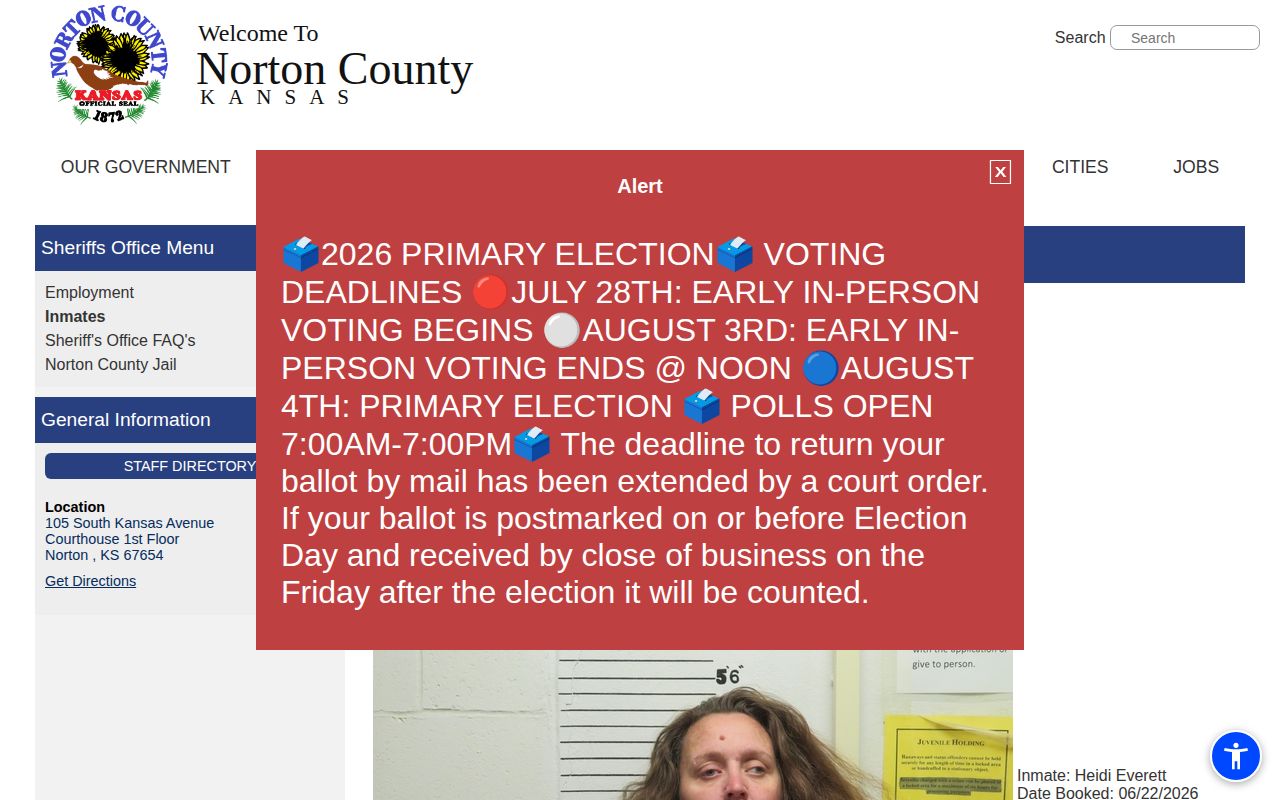
The view can support a dated roster observation. It cannot identify who left during three prior days or why an entry stopped appearing.
Check Norton County 72-Hour Releases
Start and end timestamps keep a three-day request clear. State whether the interval is a rolling 72 hours or three named calendar dates. If it crosses a weekend or holiday, list each date. Ask for an existing release log or the separable movement entries, since Kansas open-records law does not require the sheriff to create a new report.
- Write the beginning and ending date, time, and time zone for the full interval.
- Record when the current-inmate page was viewed and preserve only the observation needed for verification.
- Contact the Norton County Sheriff’s Office, 105 South Kansas Avenue, Norton, KS 67654, at 785-877-5710 and ask for the records custodian’s submission method.
- Request existing release-log, jail-register, and custody-movement entries within the stated window.
- Ask for release date and time, type or code, booking number, case number, and destination agency if recorded.
- Compare the response with court entries and any VINE notice to classify each movement correctly.
A narrow calendar-day question may fit the 24-Hour Releases process better. The three-day request should be used when the actual day is uncertain or several dates must be checked as one defined interval.
For a full interval, a request can identify the desired report by dates rather than listing names. If no such report exists, ask for existing release and movement entries that fall in the window. For one person, include the name, aliases, approximate booking date, birth date or booking identifier, and the related case number when known. Clear identifiers reduce mistaken matches across a longer period.
Norton County Three-Day Fields
Norton County has no public three-day field set. A transparent field table must show that gap instead of turning live custody fields into release data. The requested record may include more information, but availability and any lawful limits are determined by the custodian.
| Field | Where it comes from | What it establishes |
|---|---|---|
| Name | Current roster or requested record | Identity must still be matched with another identifier. |
| Date booked | Current roster | Start context, not a release date. |
| Charge and bond | Current roster and court file | Case context, not proof that bond was posted or release executed. |
| Release date and time | Sheriff release or movement record | When physical county custody ended or changed. |
| Release type or code | Sheriff record | Whether the event was bond, time served, court order, transfer, or another recorded type. |
| Destination agency | Sheriff movement record, if maintained | Whether another agency received the person. |
Booking and case numbers make a multi-person response easier to reconcile with court files. They also reduce the risk of joining records for people with similar names. Request the existing fields, and ask for open separable portions if the office withholds part of an entry.
Do not treat the bond amount as proof that bond was posted. Likewise, a sentence or dismissal entry does not show the moment jail staff completed an exit. The court file explains legal authority. The release or movement record documents what the holding agency did. Both can be needed when the event falls near the edge of the three-day period.
Norton County Weekend Release Checks
A three-day interval can bridge Friday through Monday or another multi-day period. That makes it useful when a person’s expected exit date is uncertain. Yet no Norton County weekend-release policy, holiday practice, universal release time, or page-update schedule was found. The window must not imply a timetable the sheriff has not published.
Use the actual jail timestamp. A court may issue a bond or dismissal order before staff complete the physical exit. A roster edit may occur later still. If the interval ends near a holiday or weekend, ask whether the existing entry falls just outside the stated cutoff rather than shifting the dates after seeing the result.
For one specific person, check the court case that produced the booking and request the sheriff record. The Norton County released inmate search distinguishes local jail, KDOC, federal, and possible immigration paths. Those sources should not be combined into one presumed timeline.
Note: Write each cutoff in full because “over the weekend” and “last three days” can describe different periods.
Norton County Release Record Fallbacks
A focused sheriff request is the primary fallback. No dedicated online jail-release KORA form, fixed fee, or local jail-record retention period was verified. Kansas law allows written requests, advance payment, and lawful fees based on furnishing cost. Ask for an itemized estimate and offer inspection if copies would add cost. The agency must act on the request as soon as possible and no later than the end of the third business day, but that rule is a response deadline, not a promise that production will be complete then.
Kansas VINE can corroborate a county-jail custody change when notification was registered while the person was held. Release, transfer, and escape are different alert events. Preserve the notice time and confirm the movement with the sheriff. The Kansas court portal can show a bond order, dismissal, sentence, probation disposition, or commitment, though a legal event is not the jail’s door timestamp.
Use KASPER only if KDOC accepted the person. A transfer to Norton Correctional Facility or another state prison may post as a KDOC movement, while a local bond release may never appear. BOP applies only to federal custody. ICE’s locator applies only when a documented immigration transfer gives a reason to search.
Norton Roster Changes Over 72 Hours
Norton’s manually presented current-inmate page has no searchable archive. Its published fields are name, date booked, charge, and bond. There is no post-release visibility period, so a person’s absence at the end of three days cannot be tied to an hour or a reason. A delayed manual change also remains possible because no cadence is stated.
Preserving dated observations can show that the public page changed between two checks. That is useful context, but it is not a substitute for the underlying release entry. An addition during the interval could be a new booking. A removal could represent community release, transfer, a correction, or another update.
The right conclusion stays narrow until official records resolve it. State that the person was displayed at one time and not displayed later, then obtain the sheriff timestamp and event type. Do not calculate an exit time from the gap between observations.
Classify Norton County Release Events
A three-day response may contain different forms of exit. Bond, time served, sentence expiration, dismissal, probation disposition, and another court-authorized action can return a person to the community. A transfer instead moves custody to KDOC, another jail, federal authorities, immigration authorities when documented, or another agency. A transfer is not a community release.
- Release record
- The event record showing when a jail custody episode ended or changed.
- Court disposition
- The legal result or order that may explain why an exit was authorized.
- Parole or postrelease
- Release from state prison into supervision, not completion of the sentence.
- Discharge
- The end of the KDOC sentence and supervision relationship.
Norton Correctional Facility is a KDOC prison in the same county, but it is not part of the sheriff roster. Its releases and transfers belong in KASPER and KDOC records. Keeping the county jail and state prison separate prevents a local three-day request from being described as a countywide list of every person leaving all custody.
A person released from prison to parole or postrelease supervision has left the institution but has not necessarily finished the sentence. A discharged KDOC record indicates a different stage. At the county jail, probation or bond supervision can follow release without making the event a KDOC prison release. Use the agency named in the underlying record.