
Norton County Release Date Types
A projected or anticipated date is a calculation. It is not proof that the person crossed the jail or prison gate. The Kansas Department of Corrections locating information says KASPER may show an anticipated release date and warns that dates change. KASPER is the Kansas Adult Supervised Population Electronic Repository. It covers people in the KDOC population, including many records that remain searchable after discharge. It does not cover every booking at Norton County Jail.
An actual release is a recorded movement. For the county jail, the Norton County Sheriff’s release or movement entry is the best proof of the physical exit and its time. For Norton Correctional Facility, a KASPER movement and KDOC record identify what occurred. Release to parole or postrelease supervision is not sentence discharge. A transfer to another jail, prison, federal agency, or immigration authority is also not community release.
Lookup Norton County Release Dates
Begin by identifying the institution. Norton County contains both Norton County Jail and Norton Correctional Facility. They use different records. The jail is run by the sheriff. The correctional facility is a state prison run by KDOC. A name on the county’s current-inmate page should not be searched as if it were automatically a KDOC case.
- Confirm the custodian. Check whether the person is at the county jail, a KDOC prison, or has moved elsewhere.
- For KDOC custody, search KASPER. Open the official KASPER search, accept its terms, and search by name or KDOC registration number.
- Match the identity. Compare the registration number, identifying details, conviction county, case, housing, and movements. Do not rely on a name alone.
- Read the exact date label. “Anticipated release date” is prospective. A later movement, supervision status, or discharge record answers a different question.
- For county custody, use local records. Compare the sentencing case with the sheriff’s release entry. Ask about jail credit and any local rule instead of applying KDOC credits.
The Norton County inmate page shows current inmates with name, booking date, charge, and bond. It provides no projected-release field. Disappearance from that page proves only that the page changed. The cause may be release, transfer, or an update delay.
KASPER Release Date Evidence
KASPER is most useful for a person who entered KDOC custody. Its documented fields include identifying information, a photograph, convictions and cases, housing and movements, parole office, custody or supervision level, disciplinary findings, and an anticipated release date. KDOC says the repository updates each working day. That schedule means a court action or prison movement may not appear at once.
The official KASPER entry screen shows where the state search begins.
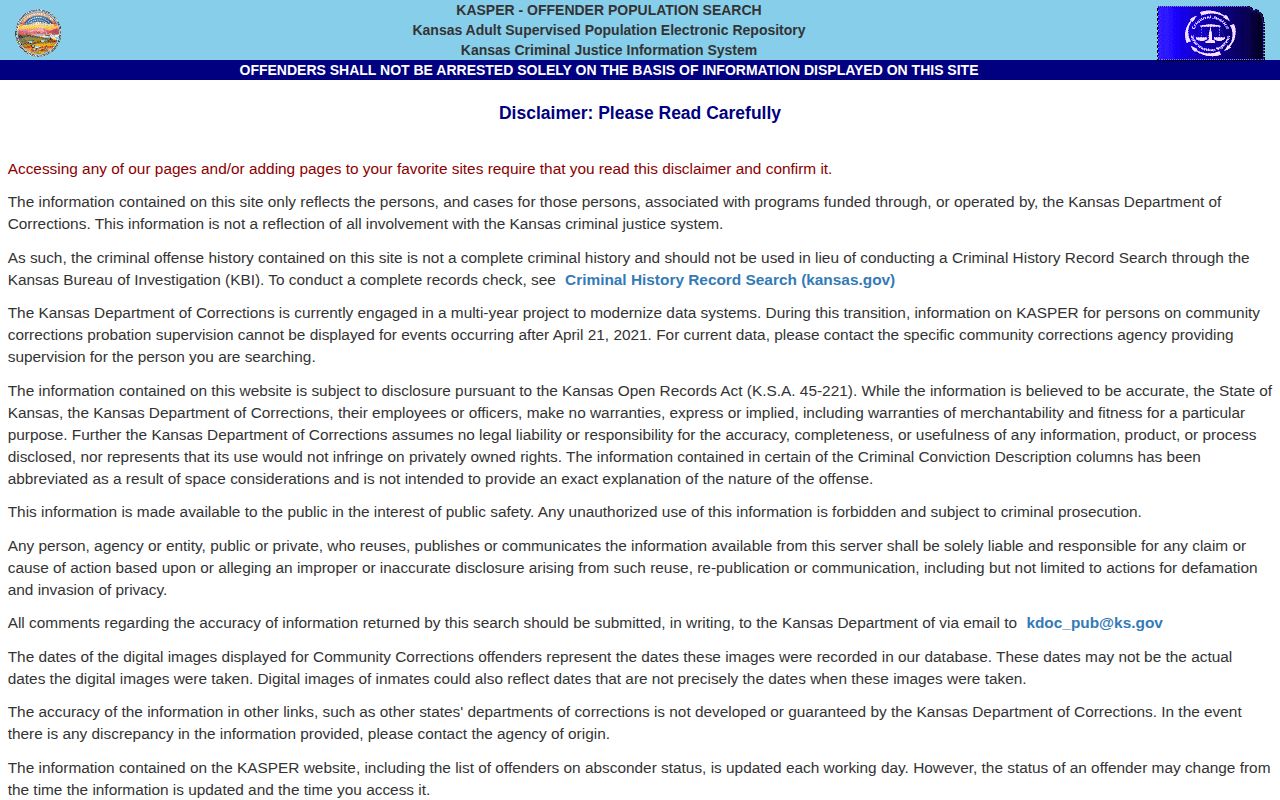
Use the screen to reach the live search, then preserve the access date and exact field wording. A projected date that has passed still needs a movement or discharge check.
KDOC’s own explanation of scope and changing dates supplies vital context for any result.

This source helps distinguish a computed date from proof of release and explains why a recent change may not yet be visible.
Identity matching matters as much as the date. Common names can lead to the wrong state record, and conviction county is not necessarily the place where a person is housed or plans to live after release. Compare the KDOC registration number and case data before recording the anticipated date. If a result lists a parole office, that is evidence of a supervision relationship. It is not, by itself, a maximum-sentence discharge.
Kansas Credits Change Release Dates
Kansas good time is sentence credit that must be earned and retained. Under K.S.A. 21-6821, many determinate prison sentences for crimes committed on or after July 1, 1993 have a 15 percent good-time cap. Selected nondrug severity-level 7 through 10 crimes committed on or after January 1, 2008, and specified drug categories, may have a 20 percent cap. “Serve 85 percent” is therefore shorthand for one category, not a rule for every Kansas sentence.
The same law permits up to 120 days of program credit for certain eligible sentences and successful program completion. Eligibility depends on offense and severity. Some sexual or sexually motivated offenses receive different treatment, and sex-offender treatment itself does not earn program credit. A simple online percentage calculator cannot resolve these facts safely.
Older indeterminate sentences may use the good-time table in K.S.A. 22-3725. Parole eligibility can also turn on K.S.A. 22-3717, the offense date, sentence type, and statutory exceptions. Life sentences and specified murder provisions do not fit the standard determinate model.
Norton Jail Date Calculations
No published Norton County jail good-time policy, weekend-release policy, or online projected-date field was verified. County jail dates must come from the sentencing order, the credit for days already served, and any local policy confirmed by the sheriff. KDOC’s 15 percent, 20 percent, and program-credit rules should never be copied onto a county-only sentence.
Norton County Court Services also handles bond supervision. A person may leave jail under a bond order while remaining subject to court conditions. That event is neither parole nor completion of a jail term. Verify the order with the 17th Judicial District Court Services office, and verify the actual exit with the sheriff. These two records answer separate parts of the question.
A pretrial detainee has no computed sentence-release date. Bond may authorize release once its conditions are met, but the sheriff still records the physical exit. A dismissal, amended order, time-served judgment, or new hold may also control. The Kansas District Court Public Access Portal can identify public case events, while the sheriff’s record confirms whether and when the order led to release.
- Jail credit
- Days a court credits toward a sentence for qualifying time already spent in custody.
- Detainer
- A request or legal hold from another authority that may prevent community release.
- Discharge
- The end of the sentence or supervision obligation, not merely departure from a facility.
Norton Release Dates Can Move
A single field cannot show every event that affects sentence computation. The controlling agency must apply the judgment and current law to the individual record.
| Change | Effect on the date | Best record |
|---|---|---|
| Good time earned or forfeited | May move a KDOC anticipated date earlier or later | KDOC sentence computation and disciplinary record |
| Program credit | May reduce an eligible sentence after credit posts | KDOC program and sentence record |
| Court correction or jail credit | May require the sentence to be recalculated | Sentencing docket and amended order |
| Consecutive or concurrent sentences | Changes how multiple terms relate | Judgment and KDOC computation |
| Detainer or transfer | May end one custody while another begins | Movement record and destination agency |
| Parole process | Applies to eligible cases but is not a promise of release | Prisoner Review Board and later KASPER movement |
KDOC identifies 785-296-3317 for state sentence-computation questions. That number is for KDOC matters, not Norton County jail calculations. Have the KDOC number and exact date label ready when asking about a state record.
Confirm Norton County Actual Release
After an anticipated date arrives, check the record again. For a state prisoner, compare KASPER movements, custody or supervision level, and parole-office information. Community supervision means the person has left prison under conditions; it does not mean the sentence has ended. Maximum-sentence discharge is documented by a discharge certificate or equivalent KDOC record.
A parole hearing date is not a release date. The Kansas Prisoner Review Board may parole an eligible person, continue the matter for more information, or pass the case for a set period. Even a favorable decision must be reconciled with the later movement record and any detainer. For guideline sentences, the Board reviews the release plan but cannot simply advance or delay the determinate prison-release date.
For Norton County Jail, request the sheriff’s release timestamp, release type or code, booking number, related case number, and destination agency if recorded. Cross-check the public court disposition, but do not assume the time of a court entry is the jail-door time. Kansas VINE can provide a custody-change notice when registration is available. Its release, transfer, and escape alerts describe different events. See the VINE Inmate Check for notification steps.
The broader Norton County released inmate search explains how court, sheriff, state, federal, and notification records fit together. It is the better route when the custodial agency is not yet known.
Note: Preserve the access date and the exact agency label because an anticipated date can change after the record was viewed.
Norton Release Date Record Trail
A court docket and a custody record answer different parts of a date question. The court can show bond modification, dismissal, a sentence, jail credit, probation, or commitment to KDOC. It does not necessarily show the minute the holding agency carried out that order. For a local episode, request the sheriff’s existing release or movement entry and compare its timestamp with the public case.
Norton District Court offers a statewide portal, a free courthouse terminal, and fax, mail, or in-person requests. The county lists prints at 25 cents per page, certification at $1, and a possible $5 research charge for larger requests. It states a three-business-day response. Those are court access terms, not sheriff or KDOC fees.
For a KDOC case, keep the registration number with each saved result. KASPER records may remain available after discharge, and KDOC’s retention schedule preserves substantial state material. That state trail cannot establish how long Norton County keeps a jail entry because no equivalent local schedule was verified.
Norton Release Holds and Destinations
A date from one sentence does not resolve every possible hold. Another county warrant, a federal matter, or a documented immigration detainer may cause a transfer when the first custody ends. Follow the destination agency recorded by the custodian. Use BOP only for federal custody and ICE ODLS only when facts support that route. No federal prison or ICE detention center was verified inside Norton County.
A move from Norton Correctional Facility to another KDOC institution is not release. A move to parole or postrelease supervision ends prison confinement while the sentence relationship continues. The exact movement, supervision label, and later discharge evidence distinguish those outcomes.